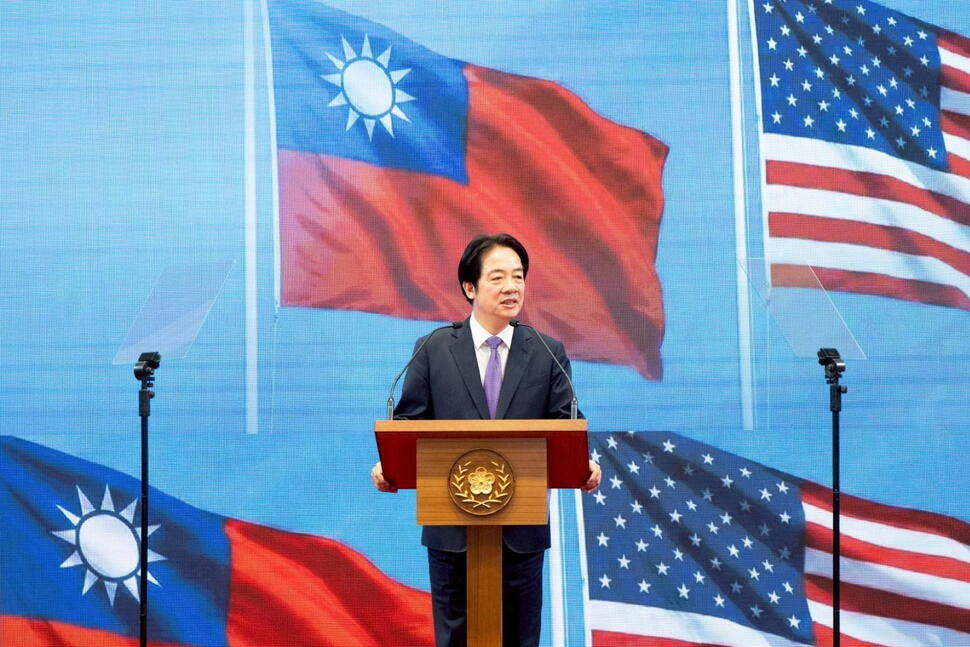
Recent comments by U.S. President Donald Trump that arms sales to Taiwan are a “very good negotiating chip” in the United States’ dealings with China are heightening anxieties on the island democracy that Beijing claims as its own.
Trump made the comment in a Fox News interview with Bret Baier that aired right after the U.S. president wrapped up a high-stakes visit to China on Friday.
China sees Taiwan as a breakaway province, to be retaken by force if necessary. The U.S., like all countries that have formal ties with Beijing, doesn’t recognize Taiwan as a country but has been the island’s strongest backer and arms supplier.
Trump is now suggesting that is open to negotiation.
Asked if he would approve a $14 billion arms package to Taiwan that has been held up for months, Trump said that’s up to China.
“I’m holding that in abeyance and it depends on China,” he said. “It’s a very good negotiating chip for us, frankly. It’s a lot of weapons.”
The U.S. is bound by its own laws to provide Taiwan with the means to defend itself and sees all threats to the island as a matter of grave concern.
By conditioning U.S. arms sales to Taiwan on his negotiations with China, Trump may play into one the island’s “nightmare scenarios,” said William Yang, a Northeast Asia senior analyst for International Crisis Group: that Taiwan, instead of being at the negotiating table, is on the menu.
Although Trump didn’t say specifically what he would want from China in return for denying Taiwan the weapons, he has been pressing Beijing to buy more American goods and to help put pressure on Iran.
China warned of ‘clashes and even conflicts’ over Taiwan
China has framed Taiwan as “the most important issue in China-U.S. relations” during Chinese President Xi Jinping’s recent summit with Trump. The visit is to be followed next week by a trip by Russian President Vladimir Putin to Beijing.
Taiwan’s presidential office on Saturday sought to smooth over the tensions by highlighting “that the consistent U.S. policy and position toward Taiwan remain unchanged.”
“The Republic of China is a sovereign, independent, democratic country; this is self-evident, and Beijing’s claims are therefore without merit,” said Presidential Office Spokesperson Karen Kuo, referring to Taiwan’s official name. She added that the island remains grateful to Trump for his support and stressed that U.S. arms sales to Taiwan are stipulated by law.
Trump wants Taiwan’s microchip makers to move to the U.S.
Another statement that raised concerns on the island was Trump’s call for Taiwan’s microchip sector — the world’s largest and most advanced — to pick up and move to the U.S.
“I’d like to see everybody making chips over in Taiwan come into America,” Trump told Fox News, describing such a move as “the greatest thing you can do.”
Trump has long pressed Taiwanese chipmakers, which produce more than 90% of the world’s most advanced chips, which are used for artificial intelligence, smartphones and military equipment, to base some of their production in the U.S.
Taiwan’s leading chipmaker, TSMC, has committed an investment of $165 billion in a mega-campus in Arizona. The island’s government, in a sweeping trade agreement with the U.S. earlier this year, pledged $250 billion in investment in the U.S. microchip sector, which included TSMC’s previous commitment.
Trump also reiterated older accusations that Taiwan “stole” its chipmaking sector from the U.S. decades ago.
Trump seems to embrace Xi’s narrative on Taiwan
While Trump during his summit with Xi did not alter U.S. policy wording on Taiwan — which many observers had feared he would — he did seem to adopt some of the Chinese president’s own narrative about the island’s government.
Beijing has branded Taiwanese President Lai Ching-te as a “Taiwan independence diehard,” and warned that he would bring war and destruction to the island.
Trump and other top U.S. officials don’t usually communicate with Taiwanese leaders but have shown support in the past for example by allowing former Taiwanese President Tsai Ing-wen to transit on U.S. soil en route to visiting Latin American countries. Lai, who is about to reach his presidency’s two-year mark, has yet to set foot on the U.S. mainland, and some observers have interpreted that as a rollback of support by the Trump administration.
In his interview with Fox News, Trump stressed that he didn’t want to see a change of status quo between Taiwan and Beijing. “But they have somebody there now that wants to go independent,” he said, likely referring to Lai.
“They’re going independent because they want to get into a war and they figure they have the United States behind them.” He added that he is not looking to fight a war thousands of miles away.
Trump’s worrying statements about Taiwan may be another instance of “his transactional rhetoric being turned up to the max,” said Wen-Ti Sung, a fellow with the Atlantic Council. “What matters more is the substance, which Taiwan is holding its collective breath for.”
Copyright 2026 The Associated Press. All rights reserved. This material may not be published, broadcast, rewritten or redistributed.
Photos You Should See – April 2026
