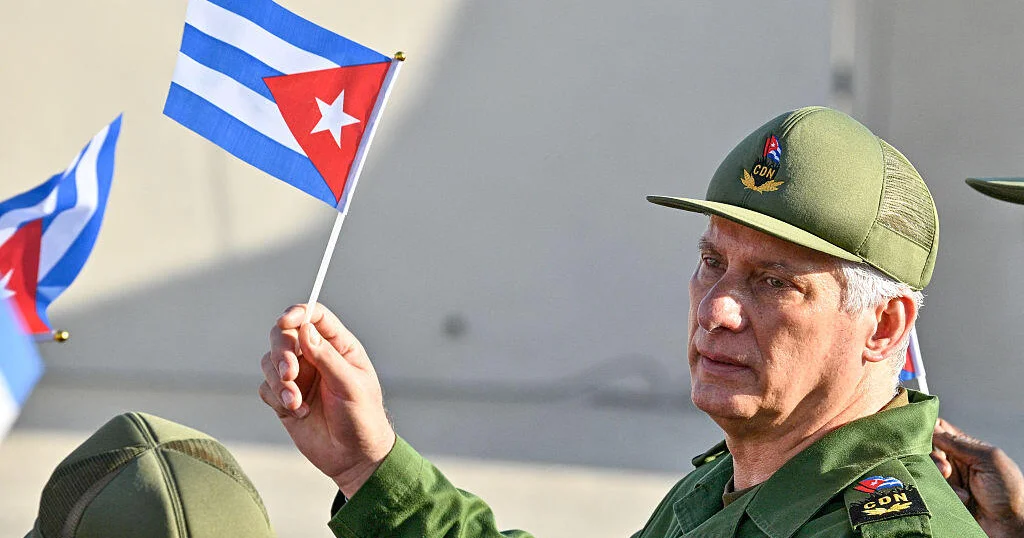
The United States has imposed sanctions on Cuban President Miguel Díaz-Canelalong with his wife and three other individuals, according to a filing Thursday from the U.S. Treasury Department. It’s the latest Trump administration move to pressure the island’s leadership.
Included in the sanctions are Alejandro Castro Espín, the sole son of former President Raúl Castro and Vilma Espín. He served as an adviser to Cuba’s Defense and National Security Commission and was present when Raúl Castro greeted then-President Barack Obama in Havana during a historic March 2016 meeting. Castro Espín’s son, Raúl Alejandro Castro Calis, was also listed.
The sanctions come after President Trump signed an executive order expanding sanctions against the island. He has been threatening military action ever since ousting Venezuelan leader Nicolás Maduro in January, and then ordering an energy blockade that choked off fuel shipments to Cuba. That has led to severe blackouts, food shortages and an economic collapse across the island.
Diaz-Canel has said that Cuba would “be ready” for a possible attack from the U.S. following threats from Mr. Trump.
Last month, the Trump administration imposed new sanctions on several Cuban senior government officials, with Secretary of State Marco Rubio warning that more sanctions would be expected.
The threats took on new weight after the U.S. announced criminal charges against Raúl Castro. The new sanctions freeze individuals’ property and bank accounts in the U.S., though it’s unclear how intertwined their finances are with the U.S. financial system.
Asked Thursday if his sanctions were meant to accelerate Cuba’s collapse, Mr. Trump said, “We just want them to be a nicely run country.”
“The country is starving and it’s got no energy, it’s got no oil, it’s got no money, it’s got nothing. It’s got a beautiful piece of land. You could have beautiful resorts,” Mr. Trump told reporters at an unrelated event in the Oval Office.
Asked whether Cuba is close to collapsing, he said, “It’s sort of collapsed,” and added that “we’re going to handle that as soon as we’ve finished” military operations in Iran.
“I like to do one thing at a time,” Mr. Trump said.
Mr. Trump has ratcheted up talk of regime change in Cuba after pledging to conduct a “friendly takeover” of the country if its leadership did not open its economy to American investment and kick out U.S. adversaries.
On May 14, CIA Director John Ratcliffe traveled to HavanaCuba, for a rare meeting with senior Cuban officials, an agency official told CBS News, using the visit to deliver a message that the U.S. was prepared to expand economic and security engagement with Cuba if Havana “makes fundamental changes.”
Also last month, the sister of the head of a company that is accused of having close ties to Cuban government operations was arrested by U.S. Immigration and Customs Enforcement officers in Miami after Rubio said that he revoked her green card. Adys Lastres Morera is the sister of Ania Guillermina Lastres Morera — the executive president of Grupo de Administración Empresarial S.A., or GAESA. Adys Lastres Morera was placed in ICE custody as she awaits removal proceedings, ICE said at the time.
Rubio has alleged GAESA has $18 billion in assets and controls 70% of the economy.
Rubio, the son of Cuban immigrants who has long taken a hard line against Cuba’s socialist leadership, has said Mr. Trump’s preference is to reach a deal with the island’s leadership but has said he is doubtful the U.S. can reach a diplomatic resolution with the current government.
Those “designated today direct or fund the regime and its efforts to mobilize its radical revolutionary movements in the United States and around the world,” Rubio said in a statement.
Rubio has defended the Trump administration’s decision to slap escalating sanctions on Havana, the largest of which is against Grupo de Administración Empresarial S.A., a business conglomerate operated by the Cuban Revolutionary Armed Forces.
Díaz-Canel was handpicked in 2018 to succeed Raúl Castro. He was the first person in decades to lead Cuba without bearing the name Castro. His term runs until 2028.
Díaz-Canel had promised to modernize Cuba’s social and economic model. But under him, the island plunged into the worst economic and energy crisis in recent history, a situation worsened by the heightened sanctions imposed by the Trump administration.
Prior to becoming president, Díaz-Canel served as Minister of Higher Education and as the first secretary of the Communist Party of Cuba.
His wife, Lis Cuesta Peraza, also appeared on the sanctions list. She does not hold the title of first lady, a title abolished in Cuba during the revolution, but in practice she acts as such, receiving other spouses such as Queen Letizia of Spain and accompanying her husband on official trips. She worked as an official in the Ministry of Culture.
Her son Miguel Anido Cuesta, who is Díaz-Canel’s stepson, also faces sanctions.
Cuban authorities did not immediately respond to a request for comment.
The new sanctions boost pressure on the Cuban government, but are far from the first time the U.S. has imposed sanctions against heads of state or government and their relatives.
The U.S. hit former Sudanese President Omar Bashir and former Zimbabwean President Robert Mugabe in the early 2000s and, more recently, targeted Maduro and his wife with sanctions.