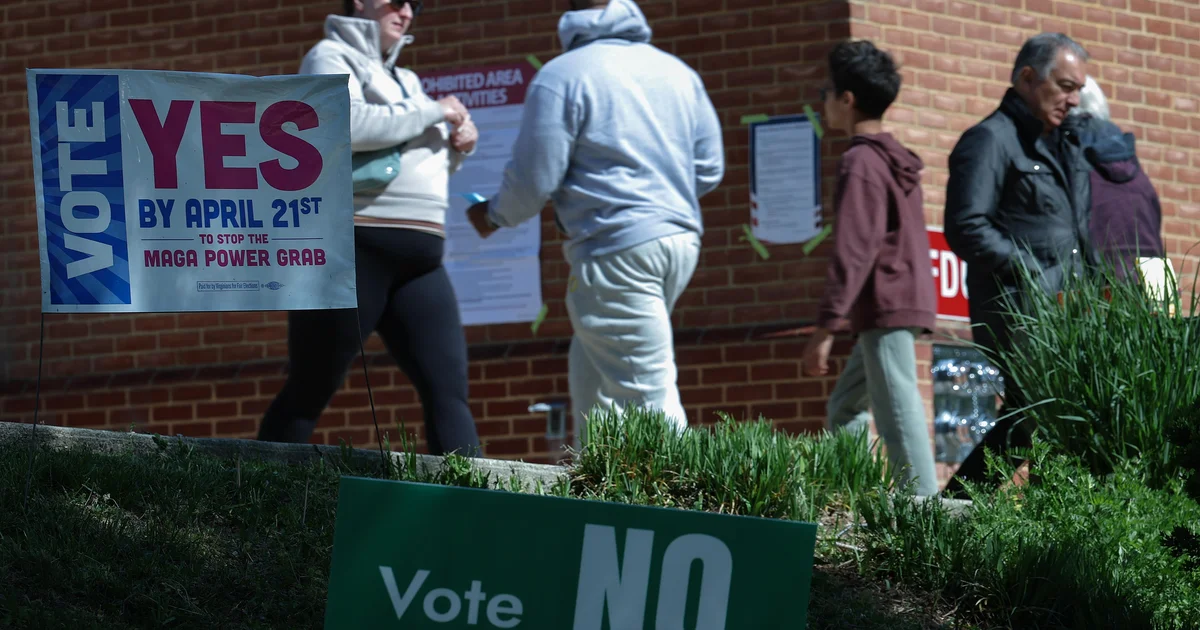
Virginia voters on Tuesday approved a new congressional map that would give Democrats an advantage in 10 House districts, leaving just one safe Republican seat, CBS News projects.
The new map could help Democrats pick up as many as four House seats, marking a major blow for Republicans in a nationwide redistricting battle ahead of this year’s midterm elections.
The referendum had been pitched by Democrats as a way to counter President Trump’s push for GOP states to redraw their congressional maps to benefit Republicans, led by Texas, which made five of its Democratic districts GOP-leaning.
A similar ballot question spearheaded by California’s Democratic Gov. Gavin Newsom sailed through last year, moving five GOP-held districts leftward and potentially canceling out Texas’ gambit.
Missouri and North Carolina followed by redrawing their maps to edge out Democrats in one seat apiece. But a measure to redraw Indiana’s map to give Republicans a 9-0 advantage failed in the state Senate and a measure pushed by Maryland Gov. Wes Moore to edge out the state’s lone Republican representative died in the state legislature.
While state legislatures can redraw congressional maps in some states, Virginia voters in 2020 approved a constitutional amendment that created a bipartisan commission to draw their state’s map. Tuesday’s referendum set aside the current maps drawn up by the commission, replacing them with maps that were drawn by the Democratic-controlled General Assembly. The previous system will be put back in place after the 2030 census.
National Democrats had pushed the Virginia referendum as a national battle against Republicans, and hoped to capitalize on Democratic Gov. Abigail Spanberger’s 15-point victory and other gains in November.
The new districts spread out the growing Democratic stronghold in northern Virginia, Richmond and Virginia Beach. Many voters in more rural parts of the state had said the new map disenfranchises them.
CBS News 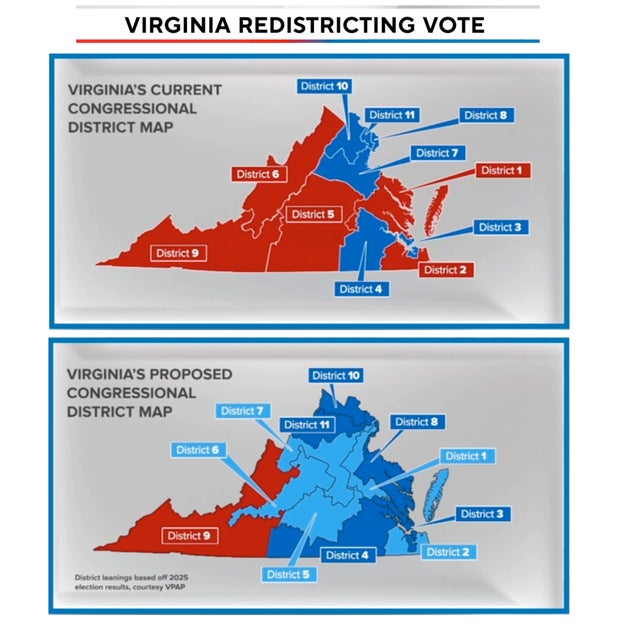
Democrats dispatched some of their most high-profile surrogates, including former President Barack Obama and his Attorney General Eric Holder, the chairman of the National Democratic Redistricting Committee. Although that committee had been focused on creating bipartisan commissions to redraw congressional maps, Holder had advocated for the Democratic gerrymander in Virginia.
He told “Face the Nation with Margaret Brennan” on Sunday that “we need to deal with the crisis that we have right now, come up with a way in which we deal with that crisis, and then get back to the redistricting commissions in California and in Virginia.”
Mr. Trump also weighed in. Despite his previous pushes for gerrymanders in GOP-controlled Texas, Indiana, Missouri and North Carolina, on Monday, he urged Virginia voters to reject the new map.
But Mr. Trump himself is facing low approval ratings, and Virginia remains especially hard-hit by the Trump administration’s federal job cuts and soaring energy prices.
Nearly $100 million has been poured into the race already, with 95% of that money donated coming from dark money groups. Virginians for Fair Elections, a group supporting the referendum, has donated $64 million, while an anti-redistricting group Virginians for Fair Maps has poured in nearly $20 million, according to data from the Virginia Public Access Project.
With Election Day less than seven months away and primaries and filing deadlines already passed, it’s unlikely many other states will take up redistricting again before 2026, although the Florida legislature is set to convene next week in a special session on the matter.
The Supreme Court heard arguments in the fall in Louisiana v. Callaiswhich could weaken Section 2 of the Voting Rights Act, which has been used to ensure minority voters have the opportunity to elect their preferred candidates. The Supreme Court has not issued an opinion in that case yet, but the ruling could result in new congressional maps in several states.
Lawsuits from GOP officials challenging the Virginia referendum are still pending in state court, though the Virginia Supreme Court allowed the referendum to go forward while those legal challenges are considered.
The U.S. Supreme Court has left in place the new maps in Texas and California.