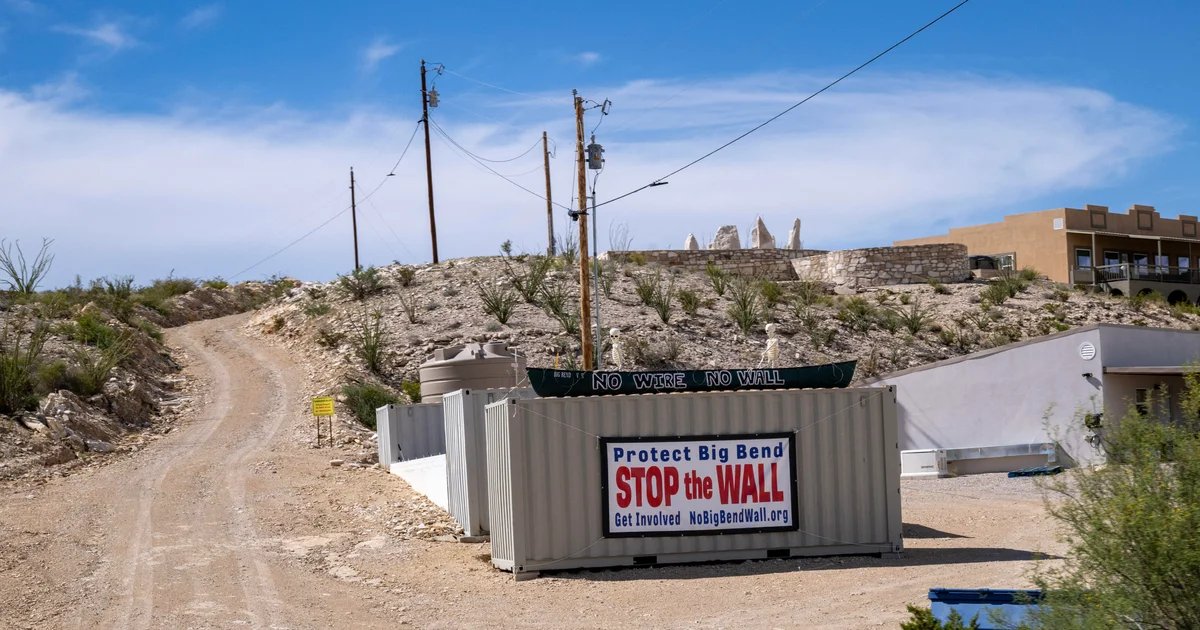
Alpine, Texas — Months after Congress approved billions for infrastructure across one of the least-trafficked stretches of the southern border, bulldozers arrived at Big Bend National Park, West Texas’s wild crown jewel.
What followed was an unlikely revolt against President Trump’s decade-old promise to build a wall. Cattle ranchers, environmentalists, sheriffs, Republican senators and country singers united around a distinctly Texas argument: Secure the border, but don’t tread on us.
Images of bulldozers scraping through the 801,163-acre expanse of Big Bend National Park — a preserve larger than the state of Rhode Island — erupted across social media, turning a construction project in one of America’s most remote landscapes into a political flashpoint.
The pictures left residents and visitors in disarray. They showed heavy machinery driving through scenery defined by an absence of infrastructure, a place boasting thousand-foot cliffs, empty desert and communities so isolated that some residents drive over an hour for groceries or to see a doctor.
More than half a million people visit Big Bend every year. The park hugs 118 winding miles of the Rio Grande, nearly a quarter of the international boundary patrolled by Customs and Border Protection in the much larger Big Bend Sector. The sector itself marks 517 miles along the river — from far West Texas east toward the Del Rio region — and its immense area of responsibility stretches across 77 Texas counties.
Nicole Sganga / CBS News 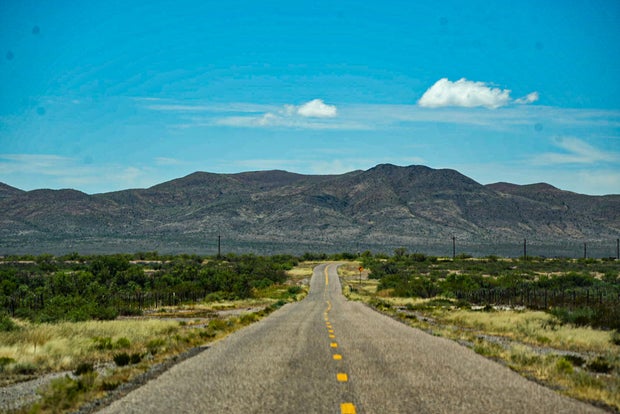
Still, CBP recorded just 3,096 apprehensions in the sector last year — about 1.3% of all Southwest border arrests. The agency reported migrant crossings there plummeted 74% from 2023 to 2025.
With total border security awards across the Big Bend Sector amounting to $7.5 billion, roughly $14.5 million in contracts have been granted for every mile of border in the sector, though the money is not distributed evenly by the mile.
On Monday, CBP Commissioner Rodney Scott announced that construction inside Big Bend National Park would be paused while he flew to West Texas for what he called a personal, on-the-ground evaluation and meetings with sheriffs, county officials and residents. He did not cancel the project, and he did not say how long the pause would last.
What Scott encountered was a fight that had become personal in the most literal sense. In West Texas, CBP’s maps run through ranches, water sources, family histories and a deeply rooted belief that land is not something you own — it is something you inherit, work, defend and pass on.
By the time Scott arrived, the argument was no longer simply about how to secure the border. It was about who gets to decide what security should cost — and what Texas will have to surrender in its name.
The failed $1 billion wall
Yolanda Alvarado was too young to understand its full impact when the steel barrier first went up on her aunt’s property near Fort Quitman in far West Texas, part of the border fencing built during the George W. Bush administration.
She remembers the crews descending on the ranch, and then, she remembers the rain.
“This wall is George Bush’s failed billion-dollar wall,” Alvarado told CBS News, while standing near the old barrier. “It took one rain for everything in this entire land, thousands of acres, to get flooded.”
Nicole Sganga / CBS News 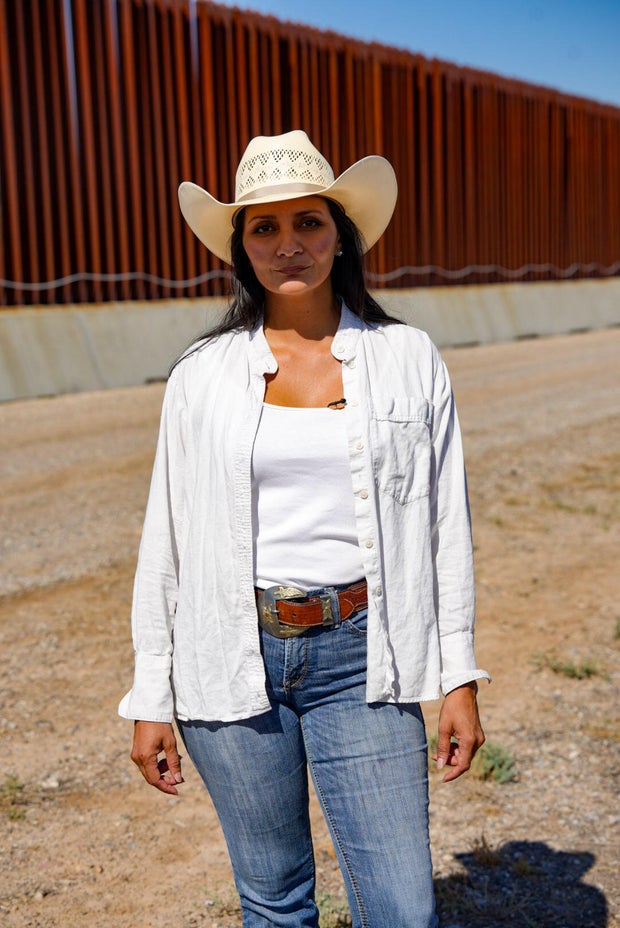
When water arrives in the deserts of West Texas, Alvarado explained, storms that collect over the mountains empty into arroyos, turning chalky washes into brown, gushing rivers that destroy whatever ranchers have placed in its path.
“Water behaves differently out here,” Alvarado said. “It’s arid terrain. Water doesn’t immediately soak in the ground, so it just runs. It’ll pull giant plants, trees, cars, vehicles.”
She recalls debris piling against the fence, while water engulfed nearby fields. “All these fields were underwater for almost 15 years,” she said, gesturing.
Now 38, Alvarado is a fifth-generation cattle rancher who finds the border wall has knocked on her family’s doorstep again.
“It’s the desert. It’s wild and beautiful and extremely vast.”
But Alvarado disputes that her home’s property is unsafe or vulnerable to mass migration, noting that she feeds cattle alone in fields where her great-grandfather planted crops.
“I sleep on the border alone,” she said. “I take my kids out there. We swim in the Rio Grande. I take friends and family there and we celebrate… I work alone all day long, just me, sometimes unarmed, but I don’t feel unsafe at all.”
Questions about what is $7.5 billion going to make safer
In February, the Department of Homeland Security formally declared the Big Bend Sector an “area of high illegal entry.” To support that designation, DHS pointed to more than 89,000 apprehensions across the entire sector over five years, from fiscal 2021 through 2025, along with a wave of drug seizures. The declaration provided there was an acute need for additional barriers and roads, waiving a list of environmental, historic-preservation laws to accelerate the construction timeline.
Still, contemporary numbers tell a different story, with available CBP figures showing only a handful of apprehensions a day across the entire 517-mile sector.
CBP Commissioner Rodney Scott has repeatedly stated that the administration cannot leave Big Bend as an opening for cartels to exploit as walls and enforcement make other portions of the border harder to skirt by.
This logic is common along the border: Harden one route, the smugglers will find another.
But administration officials have fallen short of offering more concrete evidence that the Big Bend sector, with its desolate and torturous terrain, might eventually experience the kinds of mass crossings seen elsewhere along the border, under the Biden administration.
Even within the sparse and widely untouched sector, CBP is not beginning from zero. By late 2025, the agency said it had deployed 55 autonomous surveillance towers and other detection technology across its Big Bend Sector.
Very few amid the growing opposition — including the law-enforcement officials who have spent careers patrolling the U.S.-Mexico border — argue that the boundary should be left unguarded.
Thaddeus Cleveland may be the clearest example yet.
The Republican sheriff of Terrell County spent 26 years in the U.S. Border Patrol and counts Rodney Scott as a personal friend. He believes physical barriers work in some places and supports vehicle barriers, namely where vehicles can actually drive across the Rio Grande. And when Scott flew to West Texas this week to reconsider the project, Cleveland sat across the table from him.
But Cleveland’s prescription is different: better technology, more agents, better access where agents actually need it and barriers only where the geography warrants them.
“We have what I like to call the God-made barrier,” Cleveland said.
If you travel east through Big Bend, the river begins to disappear beneath cliffs rising hundreds of feet above it. Roads thin out. Settlements vanish. Some cliffs climb up 500 feet, while others surpass 1,000.
“If they’re willing to cross that — and they do — then a 30-foot barrier on top of a thousand-foot cliff is not going to stop them,” he said, referencing the number of migrants that brave wild expanses to cross into the United States.
Terrell County is Texas’s tenth-largest county by land area, Cleveland said, but has only around 700 residents. Local revenue can afford just him and two deputies. State border-security funding helps him employ more. The $7.5 billion budgeted for that section of the wall equals roughly 2,800 years of Terrell County’s current annual budget. Asked what he would do if someone handed him that money to improve security for families he represents, Cleveland does not reference steel.
“First and foremost, more boots on the ground,” he said. “No matter how much infrastructure, whether it’s a wall, a barrier, no matter how much road work you do, no matter how much technology you put in, if you don’t have a man or a woman that can go out there and make that arrest, then you’re just wasting your money.”
He stops and thinks for a bit about what serious money can buy, then shakes his head. “We don’t have a doctor,” Cleveland offers of his county of 700 people. “We don’t have a grocery store. We drive an hour, 64 miles to get our groceries.”
“Don’t bulldoze my church”
For months, people who live here among the desert and ranches surrounding Big Bend National Park have struggled to understand what Washington was actually trying to build.
Early federal maps suggested a far more imposing physical wall across portions of the region. Plans shifted, with CBP eventually conceding there would be no 30-foot bollard wall through Big Bend National Park, but there would still be construction: more than 200 paved and repaved patrol roads, detection technology and roughly 17 miles of four to six-foot vehicle barriers. One federal contract tied to the work inside the park came to roughly $1.7 billion. Then, in August, residents began spotting the machines.
Bulldozers rolled just miles away from Santa Elena Canyon, a behemoth limestone cleft where the Rio Grande flows between cliffs that grow from the desert floor. Crews began clearing earth and vegetation for future patrol roads, what CBP called “survey and design work.”
As the machinery arrived, people who disagreed about nearly everything else began nodding their heads in agreement. Environmentalists joined ranchers. Tourism operators joined sheriffs. More than 40 Texas state lawmakers from both parties urged Gov. Greg Abbott to intervene.
Nicole Sganga / CBS News 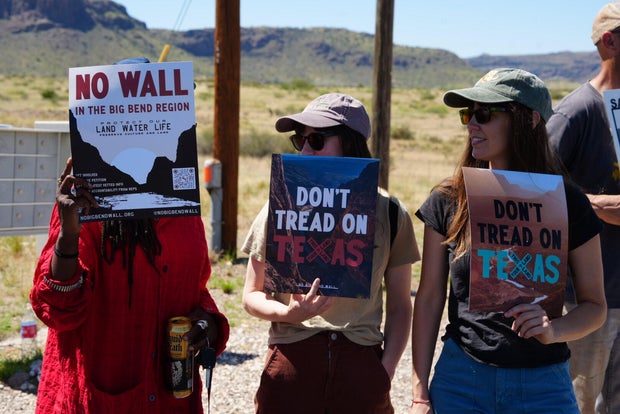
Republican Sen. John Cornyn, who lost the GOP primary this year and will not be on the ballot in November, warned the Department of Homeland Security that his constituents believed the region’s 1,000-foot cliffs and remote terrain already provided a form of border deterrence and asked federal officials to take local concerns seriously.
In an Instagram post, country singer Charley Crockett distilled the argument to a few words: “Don’t bulldoze my church. Free Big Bend.”
And then Abbott himself weighed in on the construction inside the national park.
“Every conversation that I had was that they would not be building any wall, any fence, any barrier like that,” Abbott told CBS News on Wednesday. “They had other tools and strategies where they could secure that portion of the border without erecting those types of barriers.”
Pressed on whether that meant no barriers whatsoever inside park land, Abbott repeated the commitment: “They would not be building any wall, any fence, any barrier like that.”
For a governor who has personally advocated for more walls along the southern border, the pushback was notable. But Abbott’s assurance cut against what CBP had publicly described only days earlier. Scott had ruled out a 30-foot wall, but said the agency still intended to build roads, install detection technology and place vehicle barriers in “limited, strategic locations.”
For Alvarado, confusion began months earlier. Around December, she said, contractors began searching near her property for staging areas and contacting residents about their land. By February, her family had received paperwork seeking permission to enter.
Across the broader Big Bend region, Alvarado — who works with the grassroots No Big Bend Wall coalition — says hundreds of property owners have faced requests for access or the possibility that the government could seek their land for border construction. Ranchers began whispering about eminent domain, turning a debate over federal policy into something deeply personal.
A line of wall on a federal planning map can look clean and precise. On a ranch, it can mean cattle on one side and water on the other.
“This is about sovereignty. This is about protecting our land,” Alvarado said. “There’s nothing more Texan than that.”
In Cleveland’s telling, there’s a distinctly Texan absurdity to seizing private land to build a barrier against people who might simply find a way around it.
“A lot of the American people have a false sense of security that a fence or a wall is going to stop everybody,” Cleveland said. “It’s not. There’s still a way over it, under it, or through it, and they’ll find that way.”
“What works in San Diego, what works in the Rio Grande Valley or Arizona, is not going to work here in Big Bend,” he continued. “The border is not a one-size-fits-all.”